












Evenflo vs Dr Brown: Best Bottle for Breastfed and Gassy Babies
Bottle feeding rarely feels like a small decision. What begins as a simple purchase can quickly turn into reading reviews at midnight, comparing nipple shapes, checking vent systems, and wondering why such a small item suddenly carries so much weight.
For many families, bottles are not just accessories. They are part of a feeding system. You may be exclusively pumping, combining breastfeeding and formula, or working through gas, reflux, or latch challenges. The bottle you choose becomes part of how smooth or stressful feeding feels each day.
Evenflo and Dr Brown are two of the most widely recommended brands. Both are trusted. Both are reliable. But they are built with different priorities in mind.
This guide breaks down Evenflo vs Dr Brown in a clear, practical way so you can choose based on what your baby actually needs rather than brand familiarity alone.
Key Takeaways
- Evenflo and Dr Brown are built for different feeding priorities, so the better choice depends on what you are trying to solve.
- Evenflo is usually the easier fit for simpler, more predictable feeding routines and smoother day-to-day bottle management.
- Dr Brown is often the stronger option when feeding comfort is a concern, especially with gas, reflux, or unsettled feeds.
- The real trade-off is easier routine management versus more structured feeding support.
- Looking at your bottle choice alongside your pump and insurance coverage can help you build a feeding setup that works better overall.
What Actually Differentiates Evenflo vs Dr Brown Bottles

Evenflo and Dr Brown are both well-known baby bottle brands, but they are not trying to do the same job. That is where many comparisons fall short. On the surface, both offer similar basics like multiple bottle sizes, different nipple flows, and plastic or glass options. In practice, they are built around very different feeding priorities.
Design Philosophy
Evenflo is built around simplicity. Its bottle system is designed to keep feeding and cleanup straightforward, with fewer internal parts and a nipple shape that often appeals to families switching between breast and bottle.
Dr Brown is built around intervention. Its internal vent system is not just a design detail. It is meant to change how air moves through the bottle during feeds, which is why it is often recommended for babies dealing with gas, reflux, or colic-like discomfort.
What this means: Evenflo is designed to keep the routine lighter. Dr Brown is designed to address a more specific feeding problem.
Feeding Experience
With Evenflo, the experience tends to feel more conventional. The feeding rhythm depends more on nipple shape and flow than on any internal mechanism.
With Dr Brown, the feeding experience is more engineered. The vent system is intended to support smoother milk flow and reduce swallowed air, which can matter when a baby shows signs of discomfort during or after feeds.
What this means: Evenflo tends to suit babies who already feed fairly well. Dr Brown is more often chosen when feeding comfort needs extra support.
Daily Maintenance
This is one of the biggest practical differences and one that becomes more obvious over time.
Evenflo bottles are easier to manage day to day because they involve fewer components. That matters when you are washing bottles repeatedly, preparing night feeds, or rotating through multiple bottles in a single day.
Dr Brown bottles require more handling because the vent pieces need to be cleaned and reassembled. For some families, that extra effort is worth it. For others, it becomes the deciding factor against using them long term.
What this means: Evenflo reduces routine friction. Dr Brown may reduce feeding discomfort, but it asks for more effort in return.
Best-Fit Use Case
Evenflo usually makes more sense when the main goal is a bottle that feels manageable, breastfeeding-friendly, and easy to keep in rotation.
Dr Brown usually makes more sense when the goal is not just feeding, but improving how feeding feels for a baby who struggles with gas, spit-up, or fussiness.
What this means: This comparison is less about which bottle is better overall and more about whether you need simplicity or targeted feeding support.
Also read: Best Nipple Care Creams for Breastfeeding Moms
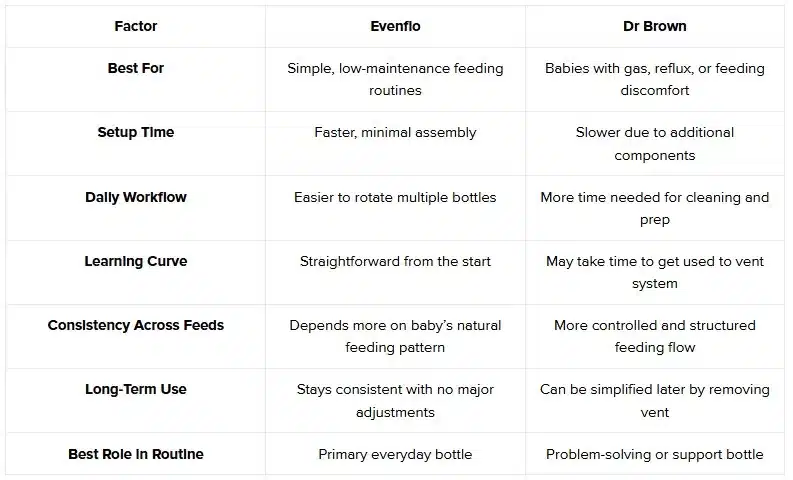
Evenflo vs Dr Brown: Quick Comparison
If you’re deciding quickly, this side-by-side view focuses on how each bottle fits into everyday use rather than repeating design differences.
Evenflo Bottles: How They Fit Into Daily Use

Evenflo bottles tend to feel predictable once they become part of your routine. There is very little adjustment required between feeds, which is why many parents settle into using them quickly without needing to rethink their setup.
What Using Evenflo Feels Like Over Time
Once you start using Evenflo regularly:
- Feeding sessions tend to stay consistent across the day
- There is less variation between bottles in rotation
- You spend less time adjusting or troubleshooting between feeds
This makes them easier to integrate into routines that involve frequent feeding, especially in the early weeks.
Where Evenflo Fits Smoothly
Evenflo tends to work well in situations where feeding is already manageable and the goal is to keep things steady.
- When you are rotating multiple bottles throughout the day
- When feeds need to be prepared quickly, including at night
- When more than one caregiver is involved in feeding
- When you want a system that does not require extra steps or adjustments
It supports routines that rely on consistency rather than intervention.
What to Pay Attention To
Because Evenflo does not actively manage airflow, its performance depends more on how your baby feeds naturally.
- Some babies may need careful flow-level matching
- Feeding comfort can vary more if your baby is sensitive to air intake
- It may not address ongoing feeding discomfort on its own
These are not drawbacks for every baby, but they become noticeable in certain cases.
How It Typically Holds Up Long Term
Evenflo tends to remain the same over time. There is no need to adjust the system or remove components as your baby grows.
For many parents, that stability becomes an advantage because the routine does not need to change as feeding patterns evolve.
Evenflo fits best into routines that are already working. It supports consistency and ease, making it a strong choice when the goal is to keep feeding simple and predictable.
Suggested read: Newborn and Infant Breastfeeding Frequency Chart
Dr Brown Bottles: How They Perform in Real Feeding Scenarios
Dr Brown bottles tend to feel more structured during use. There is a noticeable difference in how feeds progress, especially for babies who show signs of discomfort or irregular feeding patterns.
What Using Dr Brown Feels Like Over Time
Once Dr Brown becomes part of your routine:
- Feeding sessions often feel more controlled and paced
- There is less variation in how milk flows during a feed
- Babies who struggle during feeds may appear more settled over time
The system introduces a level of consistency that comes from the way the bottle is designed to regulate feeding.
Where Dr Brown Fits Best
Dr Brown tends to be used more intentionally, especially when feeding is not going smoothly.
- When feeds involve frequent pauses, burping, or fussiness
- When spit-up or reflux disrupts feeding sessions
- When you are trying to create a more controlled feeding rhythm
- When you are testing changes to improve feeding comfort
It is often part of a more deliberate approach to feeding rather than a default choice.
What to Expect in Daily Use
The added structure also changes how the bottle fits into your routine.
- Setup and cleanup take slightly longer compared to simpler systems
- Managing multiple bottles can feel more involved
- Feeding may feel more predictable, but less effortless
For some families, this becomes manageable. For others, it becomes the deciding factor over time.
How It Evolves as Feeding Stabilizes
As feeding becomes more stable, some parents simplify their setup by reducing reliance on the full system.
This allows the bottle to adapt as needs change, rather than requiring a complete switch to a different bottle.
Dr Brown works best when feeding needs support, not just convenience. It adds structure and control, which can make a meaningful difference when feeding feels inconsistent or uncomfortable.
Choosing a pump that fits your needs and is covered by insurance can remove one of these challenges. Check out Breast Pump Types!
Head-to-Head: Where the Choice Actually Gets Decided
By now, the differences are clear. What matters next is how those differences hold up when your routine is not ideal, not predictable, and not perfectly consistent.
When Things Don’t Go as Planned
Feeding rarely follows a perfect pattern. Schedules shift, babies go through phases, and what worked one week may feel different the next.
Evenflo tends to perform best when things are already running smoothly. When feeding patterns change, you may need to adjust flow levels or positioning more actively to keep things working well.
Dr Brown is often used in situations where feeding is already unpredictable. It is chosen as a way to bring more control into inconsistent feeding patterns rather than relying on the baby to self-regulate.
What this means: Evenflo works best when feeding is stable. Dr Brown is often introduced when feeding is not.
How Each Bottle Handles Growth Phases
As babies grow, feeding behavior changes. Speed, appetite, and tolerance all evolve.
With Evenflo, progression usually comes down to switching nipple flow levels. The structure stays the same, so changes are incremental and straightforward.
With Dr Brown, progression can feel more layered. Some parents continue with the full system, while others gradually simplify how they use it as feeding improves.
What this means: Evenflo follows a linear progression. Dr Brown allows a more flexible transition depending on how feeding evolves.
Consistency vs Control in Real Life
Both bottles can support consistent feeding, but they approach it differently over time.
Evenflo relies more on the baby maintaining a steady feeding pattern. When that happens, the experience feels smooth and predictable.
Dr Brown introduces a level of control that does not depend as much on natural feeding consistency. This can feel more structured, especially when feeds tend to vary.
What this means: Evenflo works with your baby’s existing rhythm. Dr Brown is often used to shape that rhythm.
Long-Term Decision Pressure
Over time, the decision often comes down to how sustainable each system feels.
Some parents continue with Evenflo because it stays low-effort and predictable without needing changes.
Others move toward or stick with Dr Brown because the added structure continues to support feeding comfort, even if it requires more involvement.
What this means: The better choice is the one you can continue using consistently, not just the one that works in the short term.
Read Next: How to Get Free Enfamil Formula for Premature Babies
Which Bottle Should You Choose
By this stage, the comparison is no longer about features. It is about identifying what will make feeding feel more manageable for you right now.
Choose Evenflo if Your Priority Is Stability Without Extra Adjustments
Evenflo tends to work best when feeding is already moving in a steady direction and you want to keep it that way.
It fits well if:
- Feeding sessions are generally calm and predictable
- You prefer a system that does not require ongoing changes
- Multiple caregivers are involved and need something easy to follow
- You want a setup that feels consistent from one day to the next
In these cases, the goal is not to fix feeding. It is to maintain what is already working without adding complexity.
Choose Dr Brown if You Are Trying to Improve Feeding Comfort
Dr Brown becomes more relevant when feeding feels inconsistent or requires more attention.
It fits better if:
- Feeding sessions vary from one time to another
- Your baby seems unsettled during or after feeds
- You are actively trying to improve how feeding feels
- You are open to a more involved setup if it supports better outcomes
Here, the focus shifts from maintaining routine to actively improving it.
If You Are Still Unsure
In many cases, the decision becomes clearer when you look at your current situation rather than trying to predict future needs.
If feeding feels manageable, starting with a simpler system often works well.
If feeding feels uncertain or requires frequent adjustments, a more structured system may offer better support.
The goal is not to choose the “best” bottle overall. It is to choose the one that aligns with what your feeding experience needs right now.
Where Your Breast Pump Setup Fits In
Bottle choice rarely exists on its own. It connects directly to how you are feeding, especially if pumping is part of your routine.
Before building out a full bottle setup, it can help to confirm which breast pump your insurance plan covers. That decision often influences compatibility, storage, and how smoothly your feeding system comes together.
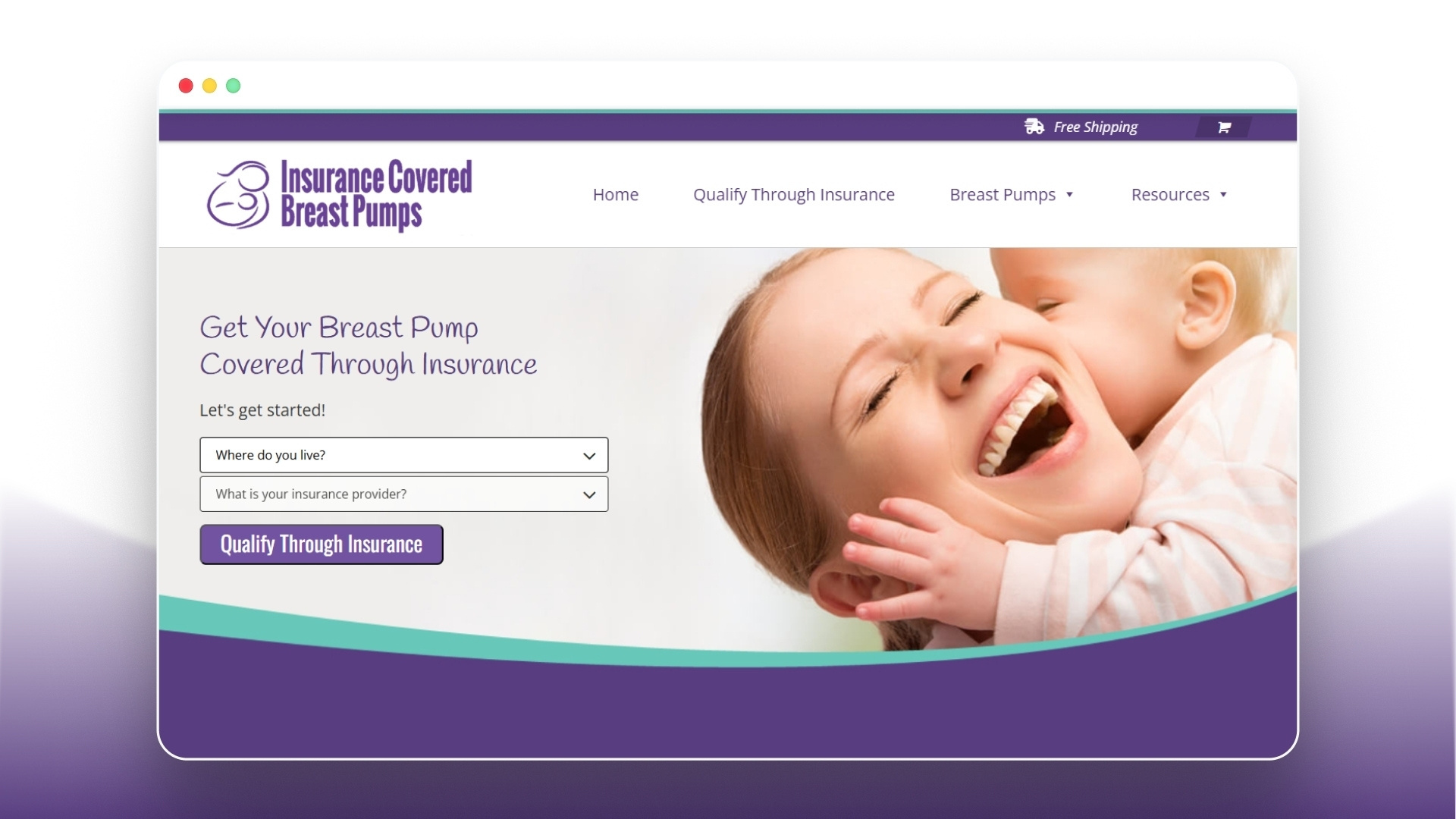
Insurance Covered Breast Pumps helps simplify this step by allowing you to:
- Check your insurance eligibility
- See which pump models are available under your plan
- Understand what is covered before making additional purchases
When your pump and bottles align from the start, feeding tends to feel more organized and less trial-and-error driven.
Taking a few minutes to review your coverage can prevent mismatched purchases and help you move forward with clarity.
Final Thoughts
Choosing between Evenflo and Dr Brown does not require overthinking every detail. Both brands are well-designed and widely trusted. What matters most is how feeding feels in your home, not how complex the bottle looks on paper.
Once your setup supports your routine instead of adding friction, confidence replaces constant comparison. Feeding decisions become easier when they are grounded in your baby’s behavior and your daily rhythm.
If you are still confirming your breast pump coverage, starting there can give you a clearer foundation for the rest of your choices. Insurance Covered Breast Pumps helps you review eligibility and available options so you can move forward without uncertainty.
Feeding does not need to be perfect. It needs to be steady, manageable, and supportive of this season of life. Contact Us for Help With Insurance Coverage.
FAQs
Q: Is Evenflo or Dr Brown better for gassy babies?
A: Dr Brown bottles are often recommended for babies who struggle with frequent gas because of the internal vent system designed to reduce air intake. Evenflo can still work well, but parents managing persistent digestive discomfort often prefer Dr Brown.
Q: Are Evenflo bottles good for breastfed babies?
A: Evenflo bottles are commonly chosen for breastfed babies because of their gradual nipple slope that supports a wider latch. However, individual baby preference plays a major role in how smooth the transition feels.
Q: Do Dr Brown bottles really help with colic?
A: Many parents report reduced spit-up and improved feeding comfort when using Dr Brown bottles for colicky babies. While no bottle eliminates colic entirely, airflow regulation may reduce feeding-related gas buildup.
Q: Which bottle is easier to clean, Evenflo or Dr Brown?
A: Evenflo bottles generally have fewer internal components, which can simplify washing and reassembly. Dr Brown bottles require cleaning additional vent parts, which adds an extra step to daily maintenance.
Q: Can you remove the vent from Dr Brown bottles?
A: Yes, many Dr Brown bottles allow the vent system to be removed as your baby grows. Some parents transition to vent-free feeding once digestive issues improve.