












Supplemental Nursing System Guide for Moms Managing Low Supply

Breastfeeding doesn’t always go according to plan, even when parents are committed and well prepared. In fact, the CDC reports that about 60% of mothers in the United States stop breastfeeding earlier than they intend to, most often because of challenges like low milk supply or ongoing latch difficulties.
When those issues come up, many parents begin looking for ways to keep their baby nourished without stepping away from the breast entirely. That search can surface options that aren’t always explained clearly or introduced early, but can play a supportive role in certain situations.
This guide focuses on one such option, a supplemental nursing system, and explains how it works, when it may be appropriate, and when professional guidance can help you use it safely and effectively.
Key Takeaways
- A supplemental nursing system (SNS) helps babies receive extra milk while staying at the breast, supporting continued breastfeeding during low supply, latch challenges, re-lactation, or lactation induction.
- Common U.S. SNS options include Medela, Lact-Aid, and Lactation Hub, each differing in design, discretion, and ongoing cost.
- SNS use requires careful setup, strict cleaning, and proper flow adjustment to ensure safe, effective feeding and avoid over- or under-feeding.
- Choosing and using an SNS is safest and most effective when guided by a Board-Certified Lactation Consultant (IBCLC), who can tailor the approach and help plan when to wean off the system.
What Is a Supplemental Nursing System?
A supplemental nursing system is a small feeding device that delivers extra milk to your baby while they are latched on to your breast.
The Basic Setup Includes:
- A container (usually a bottle or soft pouch) that holds pumped breast milk, donor milk, or infant formula.
- One or two thin, flexible tubes that run from the container to your breast.
- A way to secure the tube: typically, medical tape is placed alongside your nipple.
When your baby latches and begins to suck, milk flows from both the breast and the tube simultaneously. Your baby does not need to do anything differently: they simply latch as usual.
The container typically hangs from a cord around your neck or clips to your bra, keeping the milk at or slightly above breast level to allow a steady flow.
Note: An SNS is also sometimes called an at-breast supplementer, a nursing supplementer, or a supply line. These all refer to the same basic concept.
Why Might a Breastfeeding Parent Use an SNS?

There is no single reason someone reaches for an SNS. It tends to come up when a parent wants to keep their baby at the breast, but the baby’s milk alone is not fully meeting their needs.
Common Reasons Parents Use an SNS Include:
- Low milk supply: If your body is not producing enough milk, your baby may become frustrated, unlatch early, or lose weight. An SNS allows them to receive what they need while staying at the breast, which continues to stimulate milk production through suckling.
- Latch or transfer difficulties: Some babies have trouble drawing enough milk on their own because of a weak suck, a tongue tie, or prematurity. The SNS provides a consistent flow that keeps them engaged and fed.
- Relactation: If you stopped breastfeeding and want to start again, an SNS can help draw your baby back to the breast while your supply rebuilds, because the supplement gives them a reason to keep latching.
- Inducing lactation: Adoptive parents, parents who used a surrogate, or non-gestational parents who want to breastfeed can use an SNS as part of a lactation induction protocol.
- Avoiding “triple feeding” exhaustion: Triple feeding, nursing, then pumping, then bottle-feeding, is common but incredibly draining. An SNS can consolidate two of those steps into one feeding session.
- Baby refusing the breast: When a baby begins to prefer the bottle over the breast because of its faster flow, an SNS can offer the same fast, satisfying flow at the breast, making nursing worthwhile again.
Also Read: How to Choose the Best Breast Pump for Exclusive Pumping
How Does an SNS Work During Breastfeeding?
Understanding the mechanics helps you feel more confident before you try it.
Here is what happens:
- You fill the container with your chosen supplement: pumped breast milk, donor milk, or infant formula.
- The tubing is attached to the container and positioned along your breast, with the tip sitting just at your nipple.
- Your baby latches onto the breast as they normally would, taking both the nipple and the teat tip into their mouth.
- As they suck, milk flows from your breast and from the tube simultaneously.
- You can adjust the flow rate by raising or lowering the container: higher means faster flow, lower means slower.
What Your Baby Experiences:
From your baby’s perspective, they are simply nursing. They receive milk right away, which can be especially helpful if they have been frustrated by a slow let-down at the breast or have lost interest in feeding.
What This Means for Your Supply:
Because your baby continues to stimulate the breast through suckling, your body gets the hormonal signal: specifically, the release of prolactin, to keep making milk. This is one of the key reasons an SNS is often preferred over bottles when the goal is to increase or protect milk supply.
Also Read: Making Sense of Pumping Let Down and Supporting Your Milk Flow
SNS vs. Bottle Feeding for Supplementation

If your baby needs extra milk, you have choices, and neither path is wrong. Here is a side-by-side look at how an SNS compares to bottle supplementation, without declaring one better than the other.
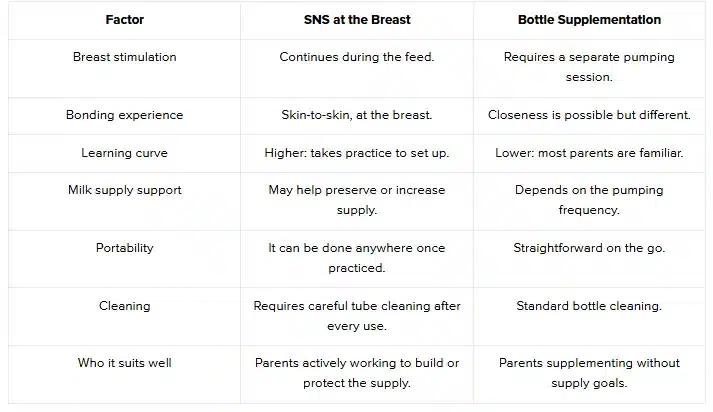
The right choice depends on your specific situation, your baby’s needs, and your feeding goals. Many families use both at different points in their journey, and that is completely fine.
Is Using a Supplemental Nursing System Safe?
For most healthy babies who can safely breastfeed, an SNS is considered a safe feeding method when used correctly and under appropriate guidance.
Key safety points to keep in mind:
- Proper hygiene is non-negotiable. The tubing must be cleaned and sanitized thoroughly after every single use. Bacteria can grow quickly inside small tubes. Always follow the manufacturer’s cleaning instructions.
- Never leave your baby unattended while using an SNS. This applies to any feeding method, but it is worth stating clearly.
- The flow rate needs to be right for your baby. Too fast a flow can cause overfeeding or choking. Too slow, and an already-tired baby may not get enough. Starting slow and adjusting with support from a lactation consultant is the safest approach.
- An SNS is not appropriate for all babies. Babies with an unsafe swallow, certain oral anatomy issues, or who cannot safely and effectively feed at the breast should not use an SNS. A healthcare provider needs to confirm that your baby can nurse safely before you begin.
- Supplement quantities should be guided by your baby’s weight gain and needs. Do not estimate. Work with your pediatrician and lactation consultant to determine how much supplementation your baby needs.
A note on commercial vs. homemade systems: Homemade SNS setups using nasogastric tubes are sometimes used, but these tubes are not designed for repeated home use and cleaning. Commercial systems, such as those made by Medela, are purpose-built and generally considered safer for long-term use.
Also Read: Best Breast Pump for Large Breasts 2026: Comfort, Fit, and Support
Are There Different Types or Brands of SNS Systems?

Yes. Supplemental nursing systems vary in design, ease of use, and ongoing cost, and different options work better for different feeding situations. In the U.S., parents typically choose between a few established commercial systems or short-term alternatives recommended by a lactation professional.
Below is a simple overview of the most commonly used SNS options and how they differ from one another.
Medela Supplemental Nursing System
This is the most widely recognized commercial SNS and is commonly used in hospitals and lactation clinics.
How it works
- Uses a hard-sided container worn around the neck.
- Thin tubing delivers milk to the nipple while the baby nurses.
- Includes a flow control clip to adjust milk delivery.
- It can be used on one or both breasts.
Why do some parents choose it?
- Reusable and durable.
- Familiar to many lactation professionals.
- Good option if you expect to use an SNS for a longer period.
Things to keep in mind
- The container is more visible and less discreet.
- Cleaning requires a bit more care because there are multiple parts.
Lact-Aid Nursing Trainer System
This system takes a slightly different approach by using a soft, disposable milk reservoir instead of a rigid container.
How it works
- Milk is stored in a collapsible sterile bag.
- As your baby drinks, the bag collapses, which may reduce the amount of air taken in.
- Tubing delivers milk directly to the breast.
Why do some parents choose it?
- Lighter and more discreet under clothing.
- Some babies swallow less air during feeds.
- Flexible and comfortable for certain feeding positions.
Things to keep in mind
- Ongoing cost due to replacement bags.
- Less commonly available in clinical settings.
Lactation Hub Supplemental Lactation Aid
This is a less widely known but U.S.-available option that some lactation professionals may recommend based on availability or preference.
What to know
- Functions similarly to other commercial SNS systems.
- Availability may vary.
- Best discussed directly with a lactation consultant who is familiar with the product.
If this option is suggested to you, your provider can help you understand setup, cleaning, and proper use.
DIY or Homemade SNS Setups
In some situations, parents or clinicians create temporary SNS setups using items like:
- A feeding syringe or bottle.
- Thin medical tubing (often a No. 5 French feeding tube).
Why are these sometimes used?
- Immediate availability.
- Lower upfront cost.
- Short-term solution when a commercial system isn’t accessible.
Important considerations
- Higher risk if not cleaned or assembled correctly.
- Flow control can be inconsistent.
- Best used short-term and under professional guidance.
DIY systems can work in a pinch, but they’re generally not recommended for long-term use without clinical support.
Also Read: Elvie vs Medela: Comparing Top Breast Pump Choices
When Should You Talk to a Lactation Consultant About SNS Use?

An SNS is available over the counter, but that does not mean going it alone is the best approach.
Reach Out to a Lactation Consultant if:
- Your baby is losing weight or not gaining as expected.
- You have been told to “triple feed” and are exhausted.
- Your baby is refusing the breast or showing signs of nipple confusion.
- You have a diagnosed low milk supply and want to continue breastfeeding.
- You are re-lactating or inducing lactation as an adoptive or non-gestational parent.
- You are unsure how much supplement your baby actually needs.
- You tried an SNS, and it is not going well.
A skilled IBCLC can assess your baby’s latch and milk transfer, evaluate your milk supply, and help you choose the right SNS setup. They can also show you how to adjust the flow and safely wean off the system when appropriate.
Need access to a lactation consultant? Many insurance plans now cover lactation consultant visits at no out-of-pocket cost under the Affordable Care Act. Insurance-covered breast pumps can help you understand what your plan covers, including lactation support through our partner, The Lactation Network.
Things to Know Before Using an SNS
Before you order one or try to set one up at home, here are a few honest things to know.
- It takes practice, and that is normal.
Most parents find the first few sessions awkward. Getting the tube positioned, managing the latch, and adjusting the flow all at once can feel overwhelming. Give yourself grace. Most parents find that it becomes manageable after a few sessions.
- It works best as part of a plan.
An SNS is most effective when it is part of a broader care plan. Ideally, one that includes monitoring your baby’s weight, tracking your milk output, and having regular check-ins with your lactation consultant or pediatrician.
- It is not forever if you do not want it to be.
Many families use an SNS short-term, for days or weeks, while milk supply builds or a baby’s latch improves. Others use it in the long term. The right timeline depends entirely on your goals and your baby’s needs.
- Cleaning takes commitment.
The tubing needs to be flushed and cleaned carefully after every feeding. This is not optional. Skipping it creates a real risk of bacterial contamination.
- Any supplementation can affect supply.
Even at the breast, supplementing can gradually reduce your milk production if you are not also stimulating your supply through frequent feeding or pumping. Your lactation consultant can help you balance this carefully.
- Your feeding journey is valid, no matter what it looks like.
Using an SNS does not mean breastfeeding is failing. It means you found a tool that keeps your baby at your breast while meeting their nutritional needs. That is something worth recognizing.
Conclusion
A supplemental nursing system will not be the right answer for every family, but for many, it can be the tool that keeps the breastfeeding relationship going when things get hard. Whether you are managing low supply, helping a baby with a weak latch, or working your way back to the breast after a break, an SNS offers a way to supplement without stepping away from nursing entirely.
The most important step before you begin is getting the right support. An IBCLC lactation consultant can evaluate your specific situation and help you decide whether an SNS makes sense and, if so, how to use it safely.
If you are navigating your breastfeeding journey and wondering what your insurance covers, from breast pumps to lactation support visits, Insurance Covered Breast Pumps can walk you through your benefits and connect you with the resources you need.
FAQs
1. Can you use a supplemental nursing system with formula?
Yes, many parents use an SNS with pumped breast milk, donor milk, or formula, depending on availability, feeding goals, and guidance from a healthcare or lactation professional.
2. How do you control milk flow in a supplemental nursing system?
Flow rate varies by system, container height, and tubing size; a lactation consultant can help fine-tune flow so feeding feels comfortable without overwhelming your baby.
3. Is a supplemental nursing system meant to be temporary?
Yes, SNS feeding can be used temporarily, but the duration depends on the progress of milk supply, the baby’s feeding skills, and whether supplementation remains medically or nutritionally necessary.
4. Will my baby get confused using an SNS?
Some babies adapt quickly, while others need time; practicing during calm feeds and working with a lactation consultant often helps babies adjust more smoothly over time.
5. Are there babies who should not use a supplemental nursing system?
An SNS may not be appropriate for babies with unsafe swallowing, certain oral conditions, or medical complexities; a pediatrician or lactation consultant should assess safety before use.