











Breast Pumping Laws in Pennsylvania: Your Rights Explained
To all the Pennsylvania moms balancing work and breastfeeding, we see you. Being a working mom is already a full plate, and figuring out how to keep up with pumping on the job can feel overwhelming.
But here’s the truth: asking for time and space to pump isn’t asking for a favor. It’s asking for rights that are already legally protected.
In Pennsylvania, while state-specific pumping protections are limited, federal laws like the PUMP for Nursing Mothers Act apply across the board. And state-level protections, like the Freedom to Breastfeed Act and regulations requiring lactation rooms in new or renovated state buildings, help fill in some of the gaps.
Whether you’re heading back to work after maternity leave, working part-time, or navigating a demanding career, this guide breaks down exactly what you need to know about pumping rights in Pennsylvania and how to confidently assert them.
At a Glance:
- You are legally entitled to reasonable pumping breaks under the federal PUMP Act and Pennsylvania law.
- Your employer must provide a private, non-bathroom space that is clean, secure, and free from intrusion.
- Most moms take 2–3 pumping breaks per 8-hour shift, but the law allows as many as needed based on your body and baby’s needs.
- Paid vs. unpaid: Breaks that overlap with regular paid breaks must be paid; extra pumping time may be unpaid but cannot be denied.
- Employers who refuse can face penalties, and you are protected from retaliation if you file a complaint.
- Simple prep tips, like packing your pump bag, wearing easy-access clothing, and using a hands-free bra, make pumping at work smoother.
Know Your Breast Pumping Rights in Pennsylvania

The PUMP for Nursing Mothers Act, passed in December 2022, is the main law that protects your pumping rights at work in Pennsylvania (and across the U.S.). It updated and expanded the Fair Labor Standards Act (FLSA) to cover more employees than before.
Here’s what it guarantees:
- Reasonable break time: You’re entitled to take breaks to express milk for up to one year after your baby’s birth. The length and frequency depend on your needs, typically two to three times during an 8-hour shift.
- Private, non-bathroom space: Your employer must provide a space that is clean, private, and shielded from intrusion. Importantly, a bathroom does not count, even if it’s private.
- Coverage for more workers: Unlike the older 2010 Break Time law (which left out salaried and many professional workers), the PUMP Act now covers nearly all employees, whether hourly or salaried.
- Enforcement: If your employer doesn’t comply, you can file a complaint with the U.S. Department of Labor’s Wage and Hour Division. Employers who ignore the law may face penalties and fines.
State Protections (Pennsylvania Law)
- Freedom to Breastfeed Act (2007): Protects the right to breastfeed in any public or private space you’re legally allowed to be. While this law doesn’t mandate pumping breaks at work, it does normalize breastfeeding in public.
- 4 Pa. Code Chapter 67C (2018): Requires new or renovated state buildings (like government offices, courthouses, and service centers) to include nursing mothers’ rooms. These must be shielded, contain a chair, table, and outlet, and be near running water if possible.
- No additional statewide mandate: Unlike states such as California or New York, PA does not yet have its own dedicated lactation accommodation law for all private employers, which means federal law is your strongest protection at work.
What Your Employer Must Provide in Pennsylvania
Even without an extensive state law, the federal PUMP Act requires Pennsylvania employers to provide specific accommodations:
- A private, non-bathroom space: Bathrooms are explicitly not allowed. The space should be shielded from view and free from intrusion.
- Convenience and accessibility: The pumping space should be near your work area, not across the building or in an inconvenient location.
- Basic amenities: A chair, a flat surface for your pump, and an electrical outlet. Ideally, access to running water and refrigeration for storing milk should be provided.
- Flexibility: Employers should accommodate multiple pumping sessions during the day without penalizing you.
Knowing you have the right to a safe space is the first step, but the next question is usually about timing. Let’s look at how pumping breaks are meant to fit into your workday, so you can stay on track at work while keeping your baby’s needs first.
Understanding Your Pumping Breaks at Work in Pennsylvania
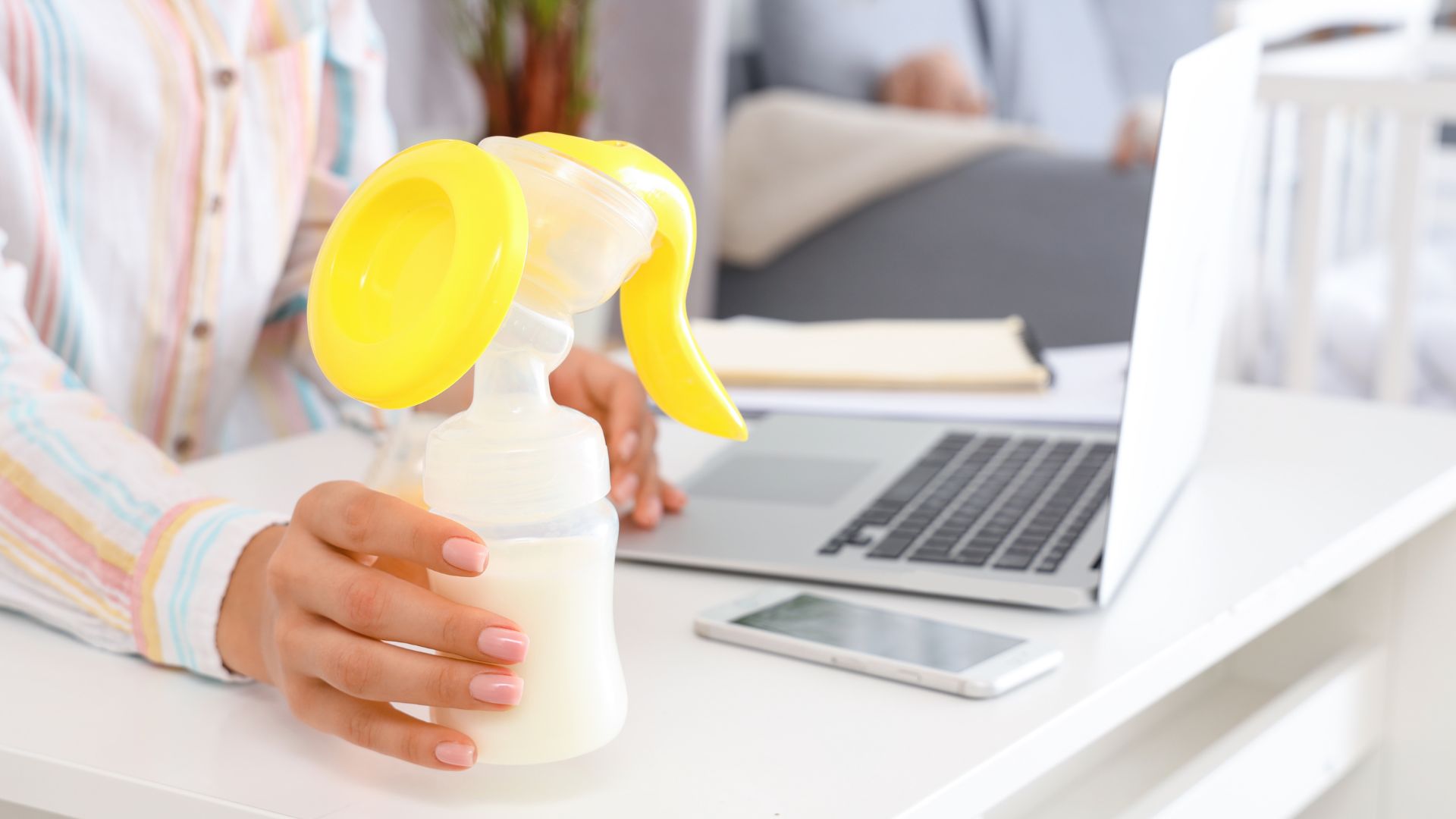
When you’re balancing work and breastfeeding, timing is everything. That’s why Pennsylvania follows federal law to make sure you have the right to step away from your desk when your body tells you it’s time to pump.
What Does “Reasonable Break Time” Really Mean?
“Reasonable” may sound vague, but in practice, it means you’re allowed the time you need to express milk without rushing. For most moms, that looks like two to three pumping breaks during an eight-hour shift, though the exact number depends on your baby’s feeding schedule, your milk supply, and your own routine.
Flexibility Matters
The law doesn’t set strict limits because every mom is different. Your employer should work with you to make sure your pumping schedule fits into your workday without compromising your baby’s feeding needs. Whether you need shorter, more frequent breaks or fewer, longer sessions, the key is flexibility.
Paid vs. Unpaid Time
If your pumping session happens during your regular paid break, then you’re entitled to pay as usual. If you need additional time outside those breaks, your employer may not be required to pay you for it, but they also cannot deny you the time or retaliate against you for taking it.
Example: A Typical Pumping Schedule in an 8-Hour Workday
To make it more real, here’s how many moms structure their day:
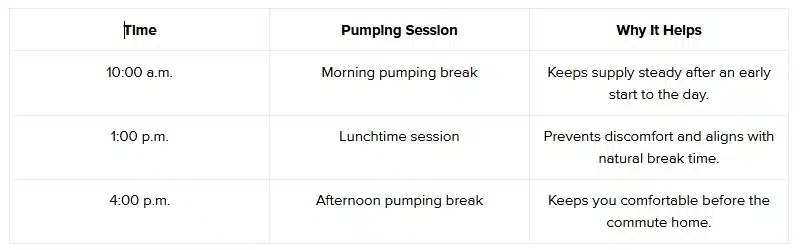
This kind of routine helps maintain milk supply and keeps you comfortable throughout the day. Of course, your exact schedule will depend on your baby’s needs and your own body’s rhythm.
What to Do If You’re Not Given Time or Space to Pump

Even though Pennsylvania law (alongside the federal PUMP Act) makes it clear that employers must provide reasonable break time and a private, non-bathroom space for pumping, not every workplace gets it right. If you find yourself without proper accommodations, know that you do have options, and you’re not alone in this.
Start with a Conversation
Sometimes, it’s a simple oversight rather than an intentional denial. Consider:
- Talk to your manager or HR: Calmly explain that you’re entitled to pumping breaks and a private space under both federal and state law.
- Use documentation: Bringing a copy of the PUMP Act or Pennsylvania’s workplace protections can help clarify the rules.
- Be specific: Suggest practical solutions, such as an unused office, a wellness room, or a quiet corner that can be converted into a private pumping space.
Escalate if Needed
If your initial conversation doesn’t resolve the issue, you may need to take things further.
- File an internal complaint: Most companies have a formal grievance process. Submitting your request in writing ensures there’s a record.
- Contact the U.S. Department of Labor (DOL): Since the PUMP Act is federal law, the DOL is authorized to investigate complaints.
- State-level support: Pennsylvania’s Department of Labor & Industry can also be a resource if you feel your rights aren’t being respected.
Know the Penalties for Employers
Employers who fail to provide pumping breaks or space can face:
- Fines: The DOL can impose penalties for non-compliance.
- Legal action: Employees may have the right to file a lawsuit for damages caused by violations.
- Reputation risk: Companies can face public backlash for failing to support working mothers.
You’re Protected from Retaliation
One of the most important things to remember is that the law protects you from retaliation. Your employer cannot legally fire you, cut your hours, demote you, or otherwise punish you for requesting or taking pumping breaks, or for filing a complaint.
| Smart Tip: Keep a paper trail. Save emails, notes from conversations, and any written requests you’ve made. This documentation can make all the difference if you ever need to escalate the issue. |
Tips to Make Pumping at Work a Little Easier

We know pumping at work can sometimes feel overwhelming, between finding the time, managing your supplies, and keeping up with your workload, it’s a lot to juggle. But here’s the good news: with a few simple adjustments, it can become a smoother part of your day. Think of these tips as little ways to make your routine gentler on yourself while still giving your baby what they need.
- Pack your bag the night before: Having your pump, bottles, storage bags, and wipes ready to go means one less thing to stress about in the morning rush.
- Try a hands-free bra: This can be a game-changer. It frees up your hands so you can check emails, scroll through photos of your baby, or simply relax while you pump.
- Wear easy-access clothing: Tops with zippers, wrap dresses, or button-downs make sessions quicker and less stressful. Comfort is everything.
- Keep a spare shirt at work: Spills happen, and having a backup can save you from feeling self-conscious the rest of the day.
- Stay connected with other moms: Talking to coworkers or friends who’ve been there reminds you that you’re not alone, and they often have practical hacks that really work.
- Give yourself grace: Some days pumping will feel like a breeze, and other days it might feel harder. Both are completely normal.
Every ounce you provide is a gift, and you’re doing an incredible job balancing motherhood and career.
Final Words
Balancing breastfeeding and work isn’t always easy, but knowing your rights in Pennsylvania can make the journey a little smoother. Both state and federal laws are on your side, ensuring that you have the time and space you need to pump without guilt or fear.
Remember, asking for these accommodations doesn’t mean you’re asking for a favor; you’re simply exercising the protections the law guarantees for you and your baby.
And whenever challenges arise, know that you’re not alone: resources, legal protections, and supportive communities are here to back you up.
You deserve this support, and your baby deserves it too.
FAQs
Q1. Can my employer require me to use my regular break or lunch time for pumping?
No. While you can use your regular breaks if that works for you, the law requires additional reasonable break time for pumping if you need it.
Q2. Does my employer have to pay me during pumping breaks?
If your pumping time overlaps with a paid break, then yes, it should be paid. Extra pumping breaks may be unpaid, but your employer cannot deny them or penalize you for taking them.
Q3. What if my workplace is small and doesn’t have extra rooms?
Even small employers are required to provide a private, non-bathroom space. This could be a conference room, office, or even a temporary setup, as long as it’s private, clean, and free from intrusion.
Q4. How many pumping breaks can I take during my shift?
Most moms take 2–3 breaks in an 8-hour shift, but the law doesn’t set a limit. You can take as many breaks as you need, based on your baby’s feeding schedule and your body’s needs.
Q5. Can I be fired or punished for asking for pumping breaks?
No. Retaliation is illegal under both federal and Pennsylvania law. Your employer cannot reduce your hours, demote you, or treat you unfairly for exercising your right to pump.